Crusher Run Calculator: Sizing the Breaker Run Under a Traffic Bond Drive
Enter your project dimensions
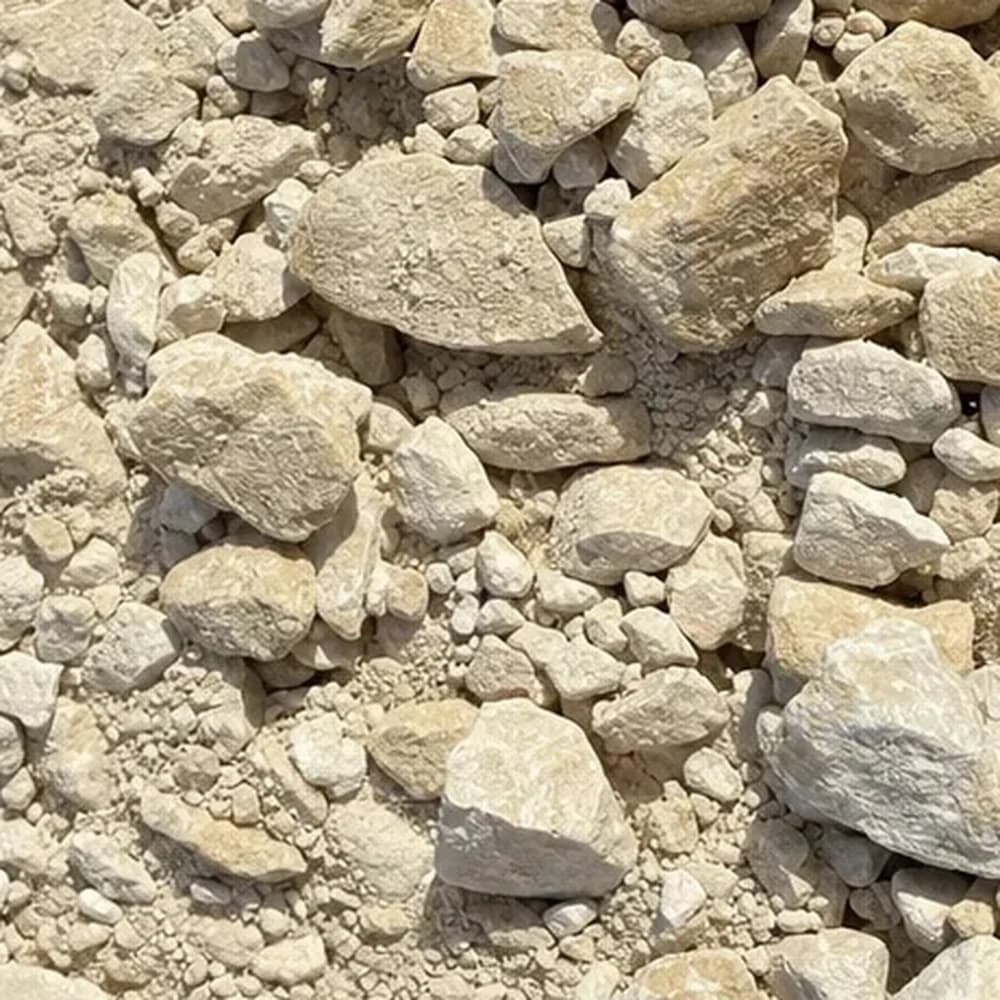
Walk a farm lane in the second week of April and the whole story is lying on the surface. A rut holding meltwater. A soft place at the gate that pumps under a loaded tire. A shoulder that has crept into the grass because the stone had nothing firm to sit on. Those are sub-base faults, and they are also measurements you can take with a tape this afternoon. Hand them to the crusher run calculator and you get the tonnage of the layer that goes in first. On this site that layer is Breaker Run: stone taken through a primary crusher to six inches or less in at least one dimension, not screened or crushed again, and placed under traffic bond rather than over it.
Two ways a sub-base order misses, both visible from where you stand
The first is measuring the drive instead of the cut. Breaker Run is placed on stripped subgrade, after sod, topsoil and any black muck have come off. That cut runs wider than the finished driving surface and usually longer, because it carries past the last stone into the turnaround. Size the hole you are filling, not the strip you will eventually drive on.
The second is the depth box. Loose stone stands higher than the same stone after a roller has been over it, so a figure taken off a fresh spread leaves the job short before the last lift goes down. Type the thickness you want when the work is finished.
Checklist before the tape comes out:
- Strip first, measure second. A depth read over sod is a guess.
- Take depth in three or more places along the run and average them.
- Write the sub-base and the cap on paper as two separate layers.
- Mark the stretches that go soft. Those want the deeper figure, not the average.
What this tool asks for once the topsoil is off
- Shape. Rectangle, circle, or multiple areas, up to five totaled together.
- Size. Length and width in feet. A circle takes a diameter instead.
- Depth. Inches, anywhere between 0.25 and 24.
- Material. The select list, which is what sets the weight behind your tonnage.
- Extra. A tick box, on by default, adds ten percent for compaction and spillage. Leave it on for anything that gets rolled.
- Result. Cubic yards, tons and cubic feet together, with the option to have the quote emailed to you.
A lane that changes width partway along is two rectangles, not one average. Enter them as separate areas and let the tool add them up.
Which weight row Breaker Run is figured on, and why the tonnage is approximate
This site publishes one row for crusher run and road base, at roughly 3,000 lb per cubic yard, which works out at 1.50 tons. That row describes a dense-graded base, and Breaker Run is not one: it is a coarse, open primary-crusher product that lies with larger voids and a rougher grading. The 1.50 figure is the only published weight here and it is what the tool applies, so treat the tonnage as an approximation rather than a delivered weight and confirm it against the ticket. Clear stone of a similar size is published lighter again, near 2,800 lb or 1.40 tons.
To check the screen by hand, turn your depth into feet by dividing the inches by twelve, multiply that by your square footage to get cubic feet, divide by twenty-seven for cubic yards, then put one and a half tons on every yard. The volume half of that is exact. The weight half carries the caveat above. The figures are dry weights, and stone loaded during a wet week weighs more per yard, which shifts what a ton covers, not what the layer has to be.
Breaker Run underneath, traffic bond over it, nothing like it in a drain line
WisDOT specifies breaker run under Section 311, on the definition above, and puts it to work mainly on subgrade correction. Dense-graded base sits under Section 305, and that is what yards here sell as traffic bond. Both are descriptions of how material is specified in this state, not certifications held by a storefront. The practical consequence for this page is the one above: Breaker Run goes in as a coarse sub-base and never as a finish course, and it is the traffic bond over it that gets driven on.
On a job that reads:
- Clay subgrade near Green Bay, the Fox Valley or the Lake Superior shore: six to eight inches of Breaker Run, then a traffic bond cap figured on its own.
- Central Sands ground that drains fast but still will not carry a loaded truck: the sub-base earns its place at the shallower end of that range.
- A construction entrance off a town road: the coarse layer alone, and thick, so tires shed mud before they reach pavement.
- Anywhere water has to move through the stone: use clear stone or drain rock instead. Breaker Run is unscreened and carries everything down to dust, so it is not a drainage material whatever its top size looks like.
Spread it in lifts of a couple of inches and roll each one. Two rolled lifts survive freeze and thaw far better than one thick placement does.
A construction entrance and a soft stretch of barn lane
Made-up jobs on a made-up property. Your tape decides the real ones.
A 45 by 12 entrance off the town road
Eight inches rolled, because loaded trailers will use it.
- 45 x 12 = 540 square feet
- 8 inches is 0.667 feet, so 540 x 0.667 = 360 cubic feet
- 360 divided by 27 = 13.3 cubic yards
- 13.3 x 1.50 = 20.0 tons
- With the ten percent ticked: 14.6 cubic yards, about 22 tons
Sixty feet of barn lane that goes soft every spring
Eleven feet wide, six inches of Breaker Run, capped with four inches of traffic bond.
- 60 x 11 = 660 square feet
- Sub-base: 660 x 0.5 = 330 cubic feet; 330 divided by 27 = 12.2 cubic yards; 12.2 x 1.50 = 18.3 tons
- Cap: 660 x 0.333 = 220 cubic feet; 220 divided by 27 = 8.1 cubic yards; 8.1 x 1.50 = 12.2 tons
Two calculations, two products, one delivery date. Size the cap on the road base calculator so the depth guidance matches the layer you are actually buying. A patio or walk base is different again, and gets sized on the paver base tool, which builds in the skirt of stone past the pavers.
Getting it rolled before the ground closes
Frozen ground will not compact, so a sub-base placed in December is a sub-base that gets rolled in April. Work the window that runs from the end of the thaw into late fall. Spring weight limits sit on Class II state highways from about early March into May, and town and county roads can be posted as well, so check the route into your own lane before you set a date.
Order a shade long. A half ton left on the pile fills the frost boils that show up next March, and stone standing in a heap is a smaller problem than a lane that stops ten feet short. When the tonnage looks right, open Breaker Run, set the tons and a date, and check out. Delivery is arranged at checkout by ZIP code, and what the truck needs at the other end is covered on the delivery page. Anything the tool cannot divide, send through the contact page with your measurements.
Common questions
The pad wraps around the pole shed in an L. Do I work the corner out myself?
No. Switch to multiple areas and enter it as two rectangles that meet at the corner, taking care not to count the overlap twice. The tool totals up to five areas and returns one set of yards and tons, so a lane, a turnaround and a shed apron can all land on the same order.
Does the stone shoulder either side of the lane belong in the width I type?
Yes, if you are putting stone there. A shoulder is part of what gets filled, and leaving it out is one of the commonest reasons a lane order finishes narrow. Measure out to where the stone will actually stop, not to the tire tracks.
Breaker Run goes in first and traffic bond caps it. Is that one calculation or two?
Two. Same footprint, different depth, different product, so run the tool twice and write each result down separately. The weight per yard happens to match on those two rows, but the depths do not, and they go on the order as two separate lines for the same date.
The lane bends around a rock outcrop before it reaches the shed. What do I enter?
Break the bend into straight pieces, measure each one down its center line, then enter them as separate areas. Curves are forgiving here, because a little extra stone in a bend is stone you will want anyway once trucks start cutting the inside of the corner.
The lane is sound but the thaw left three soft holes in it. What depth goes in the box?
The depth of the holes, not of the lane. Measure each one at its deepest point, use the area you will patch rather than the whole run, and calculate it as its own small job. If the same holes come back every spring, the sub-base under them is thin and a patch is only buying you a season.
Related calculators
Base tonnage sorted? Good.
Crusher run by the ton, the cheapest structure on the yard, delivered free.