Road Base Calculator for Traffic Bond Lanes and Pads
Enter your project dimensions
Walk the lane in the first week of May and it tells you most of what you need. Two ruts polished down to clay where the pickup runs. A shoulder that has crept inward under the mower. A soft low end that will not carry a propane truck until June. The road base calculator on this page turns all that into cubic yards and tons. The one thing it cannot see for you is the width you actually drive on, and that is the number that moves an order more than anything else on the form.
The ruts, the creep and the width nobody measured twice
Three things put a lane order out, and all three are visible from where you are standing.
- The width drifts. A lane built at twelve feet is often eleven by the time grass has closed in from both sides. Tape the running surface at its narrowest, at its widest and somewhere in the middle, then use the average.
- The depth gets read loose. Four inches tipped is not four inches rolled. The box wants the layer you intend to finish at, after the plate or the roller has been over it.
- The soft end is not like the rest. A lane that is sound for a hundred feet and sinks in the last twenty is two entries, not one averaged depth.
Checklist before you open the form:
- Pace or tape the centerline, not the outside of the bend.
- Average three width readings.
- Decide a compacted depth for each stretch separately.
- Mark where the wet ground starts and where it stops.
Depth follows what rolls over it. Four inches suits light residential use on firm ground, six carries everyday vehicles and delivery trucks, and eight to twelve belongs on soft subgrade or wherever equipment parks. Here the deciding factor is usually not the axle but the thaw. Frost drives down at least 48 inches under footings and 48 to 72 inches under a road by late winter, and no base layer reaches that. A thin one is simply the first thing to fail when the ground above the frost turns soft.
The road base calculator, field by field, from shape to emailed quote
- Shape. Rectangle, circle, or multiple areas, up to five totaled into one result. A turnaround goes in as a diameter.
- Size. Length and width in feet, or the diameter of the circle in feet.
- Depth. Inches, from 0.25 to 24. Enter the compacted depth you want to end up with.
- Material. The select list, which sets the weight used for the tonnage.
- Extra. One tick box, for compaction and spillage, which adds ten percent. It is on when the page loads and stays on until you untick it.
- Result. Cubic yards, tons and cubic feet, with the option to have the quote emailed to you.
The ten percent is applied automatically only while the box stays ticked, and it is the only allowance the form offers. Anything past that is you rounding the order up.
Twenty-eight yards of traffic bond weighs in at forty-two tons
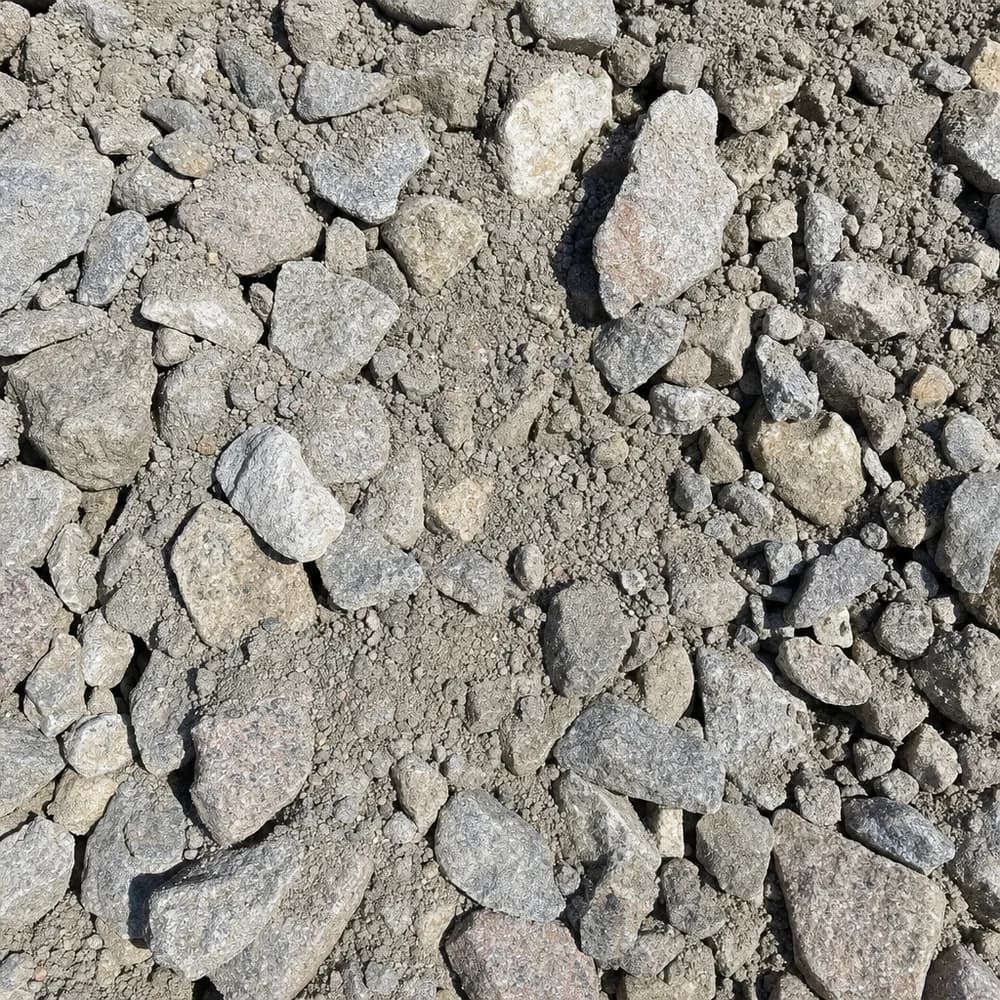
Base material is graded crushed stone with the fines left in, and the fines are what make it heavy. Reckon on about 3,000 pounds to the cubic yard, a ton and a half. Clean drainage stone at roughly 2,800 pounds and river rock at about 2,700 fill the same hole for less weight, so changing the material on the select list moves the tonnage without a single measurement changing.
To check the screen on paper: multiply length by width for the square footage, divide the depth in inches by twelve and multiply that through for cubic feet, divide by twenty-seven for cubic yards, then multiply the yards by one and a half.
Traffic bond on top, Breaker Run underneath, Screenings nowhere near a lane
- 3/4" Traffic Bond is the dense-graded base sold here for drives, lanes and pads. WisDOT specifies the same material under Section 305. That is how it is described locally, not a certification held by this storefront.
- Breaker Run is the coarse sub-base that goes under the bond on soft or clay ground, and it has a calculator of its own.
- Screenings pack hard and hold water. They are a paver bedding material, not a lane material.
- A finish course of driveway gravel over rolled bond keeps the dust down and gives an edge that looks finished.
Strip the sod and black dirt first. Stone laid over topsoil pumps mud up through itself no matter how deep it goes. On clay or ground that ruts, woven geotextile between soil and stone keeps the two apart; it is not a listing here, so source it from a local supplier. Roll in lifts of four inches or less, and build a crown of two or three percent so meltwater leaves the lane sideways instead of soaking into it.
A 150-foot approach off the town road, and the turnaround by the boathouse
Both hypothetical. Your tape decides the real ones.
The approach runs 150 feet from the town road to the garage and averages 10 feet of running surface, finishing at 6 inches compacted. That is 1,500 square feet. Six inches is half a foot, so the layer holds 750 cubic feet, which is 27.8 cubic yards. At a ton and a half to the yard, the order is 41.7 tons. With the ten percent ticked, the panel reads 30.6 yards and 45.9 tons.
The turnaround by the boathouse is a circle 26 feet across at the same depth. Circle mode gives 531 square feet, the 6 inches makes 265 cubic feet, and that comes to 9.8 cubic yards, or 14.7 tons.
Run as two areas in one pass, the job totals 37.6 cubic yards and 56.4 tons. Fifty-six tons will not sit in one heap without a machine to move it, so plan two drops along the lane rather than one at the road. Spreading distance is what makes a base job long, not the stone.
Getting it rolled before the roads are posted
Base work runs from the end of the spring thaw into late fall, and frozen ground stops compaction altogether. State highways carry spring weight limits from roughly early March into May, and county, town and village roads can be posted as well, which is worth checking before you pick a delivery week for a lane order this size. When the yardage is settled, open the product, set your tons and a date, and check out. Delivery is arranged at checkout by ZIP code, and the truck needs firm ground and clear overhead to tip on. Measurements you would rather have a second look at can go through the contact page, and access questions are covered on the delivery page.
Common questions
The parking apron runs along the cottage and then turns down toward the boat ramp. Does that go in as one shape?
Enter it as two rectangles under multiple areas and read the combined total. Cut the L at the inside corner so the corner square is counted once rather than twice. The apron and the ramp run will probably want different depths anyway, and separate entries let you give them different depths in the same calculation.
Landscape timbers box in the trailer pad. Does the frame itself go in the length and width?
Measure the stone, not the timber. Take the inside face of the frame as the edge of the area. The exception is a pad with no frame at all, where base has to run a little past the finished edge to stop it crumbling away; there, measure to where the stone will actually stop.
I do not want to drive on bare base. How do I order the top course?
As a second calculation over the same area at its own depth, usually two to three inches. Bond and a surface gravel sit on different weight rows, so a single entry covering both layers gives a tonnage that is wrong for both. Add the two results together only after the tool has priced them separately.
The yard by the barn is a fan, not a rectangle. What do I type?
Take a rectangle through the widest part of it and add a smaller one for the narrow neck at the entrance. Base is forgiving of a modest over-estimate, because the surplus goes into low spots and there are always low spots. A fan entered at its mean width is the one shortcut worth taking on this page.
Only the two wheel tracks are worn. Is there any point calculating the whole width?
Not usually. Measure the tracks as two long narrow rectangles at the depth of the rut, enter them under multiple areas, and leave the sound stone out of it. Rake the edges of each track in before rolling, or you finish with two hard ribs running down the lane.
Related calculators
Thirty tons. Zero delivery fees.
Road base priced per ton, hauled free, at lane quantities where hauling usually costs the most.