Wisconsin Gravel Calculator With a Depth Chart
Enter your project dimensions
By February the plow blade has found every thin spot in a gravel drive. The spring thaw finishes what the plow started. So settle depth before anything else, then let this gravel calculator do the arithmetic.
Depth chart
| Job | Type this depth | Pick this material row |
|---|---|---|
| Path or walkway | 2-3 in | Driveway / walkway gravel |
| Worn drive, top-up only | 2 in | Driveway / walkway gravel |
| New drive, bottom layer | 3-4 in, compacted | Crusher run / road base (traffic bond) |
| New drive, top layer | 2-3 in | Driveway / walkway gravel or crushed stone |
| Patio or fire pit seating | 2-3 in, with edging | Pea gravel or crushed stone |
| Drain line or wet hole | 12 in or more | Crushed stone (use the stone calculator) |
Checklist before you trust the chart:
- Frost goes at least 48 inches down for footings under the state dwelling code, and 48 to 72 inches under roads by late winter. No gravel layer reaches that. Thin layers heave.
- The thaw works down from the top. Meltwater sits on still-frozen ground and softens whatever is above it.
- Clay near Green Bay, the Fox Valley and the Lake Superior shore stays wet longest. Don't go thin there.
- Sand in the Central Sands drains fast. The base still has to carry the truck.
Traffic bond is what Wisconsin suppliers call dense-graded base. WisDOT specifies it under Section 305, which is how the material is described here, not a certification.
Filling in the calculator
- Shape. Rectangle, circle, or multiple areas (up to five).
- Size. Length and width in feet, or diameter for a circle.
- Depth. Inches, from 0.25 to 24.
- Material. Pick the row. Weight changes with it.
- Extra. Tick "add 5% extra for compaction & spillage" for packed stone.
- Result. Cubic yards, tons, cubic feet. Email my quote sends it to you.
Worked jobs
Made-up jobs. Your measurements rule.
Checklist for any job:
- Measure to the finished edge, not the lawn line.
- Take depth in three or more spots and average.
- Write each layer down separately.
- Note the material row next to each layer.
Splash areas under four downspouts
Four pads, each 4 x 3 ft, 4 inches of river rock. Use multiple areas and enter four identical rectangles.
- Each: 4 x 3 = 12 sq ft; 12 x 4 ÷ 12 = 4 cu ft
- Four of them: 16 cu ft
- 16 ÷ 27 = 0.59 cu yd
- 0.59 x 1.35 = 0.8 tons
Drainage stone behind a retaining wall
A 36 ft wall, 3 ft of drainage zone behind it top to bottom, 12 inches thick. The depth box stops at 24 inches, so turn the zone on its side: length 36 ft, "width" 3 ft (the height), depth 12 in (the thickness). Fill with 3/4 inch crushed stone, the clear stone many yards sell for backfill.
- 36 x 3 = 108 sq ft
- 108 x 12 ÷ 12 = 108 cu ft
- 108 ÷ 27 = 4.0 cu yd
- 4.0 x 1.40 = 5.6 tons
River rock along a pond edge
A 50 ft band, 4 ft wide, 4 inches of river rock.
- 50 x 4 = 200 sq ft
- 200 x 4 ÷ 12 = 66.7 cu ft
- 66.7 ÷ 27 = 2.47 cu yd
- 2.47 x 1.35 = 3.33 tons
- With 5%: 2.59 cu yd, 3.5 tons
A pond edge is not a lakeshore. Where waves or ice push on the bank, it's rip rap, sized on its own calculator.
What a yard weighs
- Crusher run / road base row: about 3,000 lb per cubic yard, 1.50 tons. Covers traffic bond.
- Crushed stone (#57, 3/4"): about 2,800 lb, 1.40 tons.
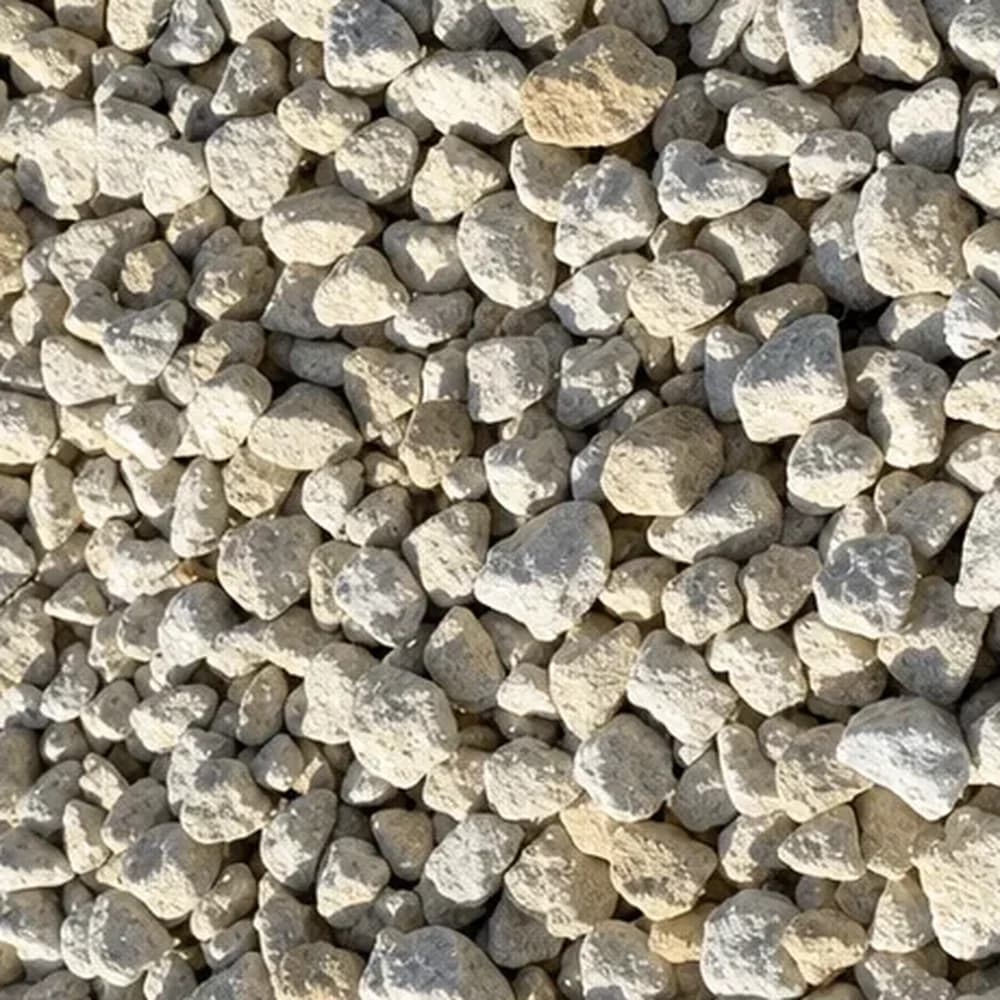
- Pea gravel (3/8"): about 2,800 lb, 1.40 tons.
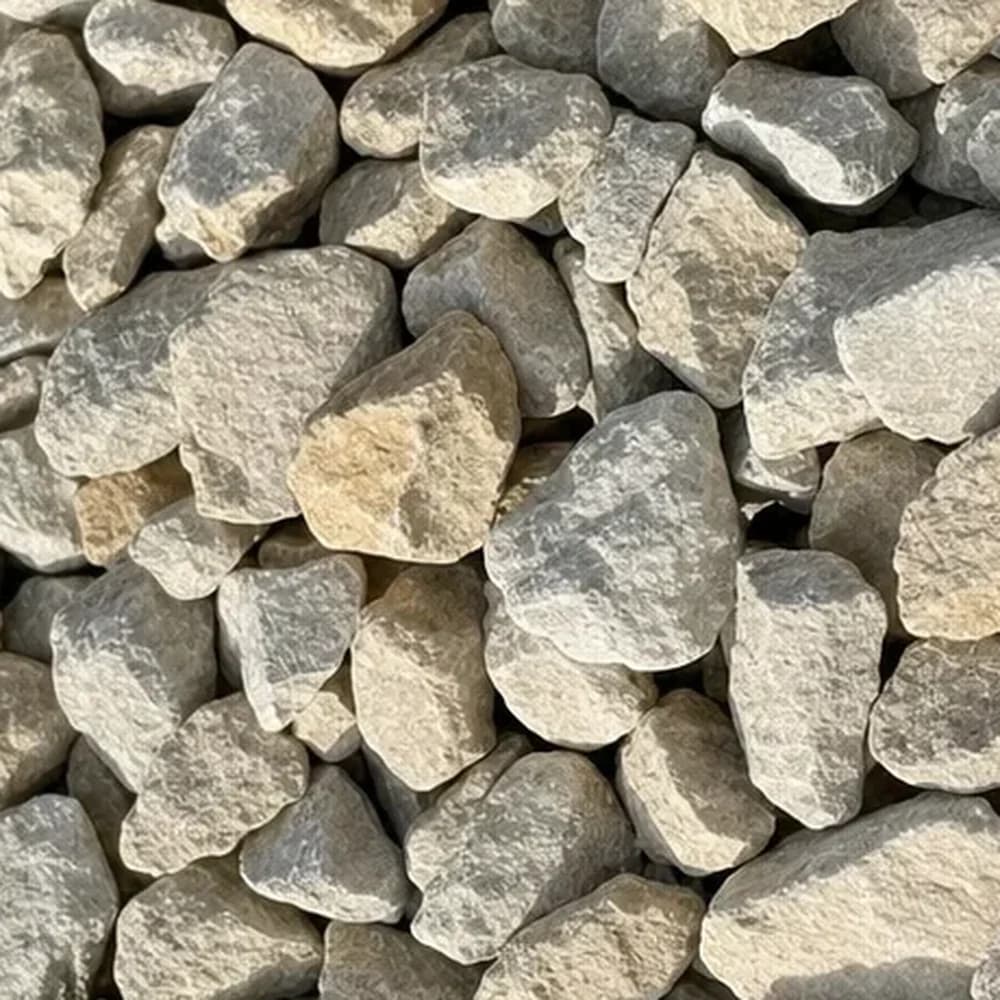
- Driveway / walkway gravel: about 2,800 lb, 1.40 tons.
- River rock (1-3"): about 2,700 lb, 1.35 tons.
Those are dry weights. Snow-soaked stone in April weighs more per yard, so a ton spreads a little thinner.
Checklist for checking the tool by hand:
- Convert depth: inches ÷ 12.
- Multiply length x width x that depth for cubic feet.
- Divide by 27.
- Multiply by the weight row.
Or in one line: length x width x depth in inches ÷ 12 = cubic feet. Divide by 27 for yards. Multiply by the figure above for tons.
Ordering slack
- Tick the 5% for anything compacted or driven on.
- Loose rock in beds needs no extra.
- Round up. A short load stops the job.
- Wait out the thaw. Base, drive and paver work runs from the end of the thaw into late fall.
- Check the ground. If a boot sinks, the base will too. Wait.
- Know your road. State highways carry spring weight limits from about early March into May, and town and county roads can be posted too. Plan delivery for your lane around that.
Order
Open the product that matches your row, set the tons and a delivery date, and check out. Delivery is arranged at checkout by ZIP code. Give the truck a clear run to a firm spot to dump, away from the septic field. Questions go to Wisconsin Rock Supply through the contact page. Mulch, black dirt and sand have their own calculators.
Common questions
My drive already has stone on it and just needs a top coat. What do I measure?
The whole surface you're covering, at the new layer's depth only, usually about 2 inches. Don't count the old stone underneath.
What happens if I order too little?
You end up with a thin patch or an unfinished top layer, and a second delivery to finish. Tick the 5% box and round up to avoid it.
Does wet stone change the tons I need?
Yes. The calculator uses dry weights. Stone that's soaked from rain or snowmelt weighs more per yard, so the same tonnage covers slightly less ground.
How exact is this thing?
The arithmetic is exact; the result is only as good as your tape and depth readings. Weights are averages, so treat tons as a close planning figure.
My yard is heavy clay and goes soft every spring. Does the gravel plan change?
Usually. A coarse layer of breaker run goes under the traffic bond on soft or clay ground. Calculate it as its own layer.
Related calculators
That tonnage ships free.
Driveway gravel, #57, crusher run: priced by the ton, delivered across Wisconsin.