River Rock Calculator for Borders, Splash Runs and Creek Lines
Enter your project dimensions
The order this page has to correct most often is a bed measured carefully and then given a depth somebody picked by eye. Two inches looks generous in a wheelbarrow. Spread under three-inch cobble it leaves fabric grinning through by the second summer, and the fix is another delivery rather than a rake. The river rock calculator gives an exact answer to the question you ask it, so the depth you type is the part worth thinking about.
The three things a bed estimate cannot know about your ground
An estimate is arithmetic on your measurements. It has no view on the ground underneath, and here that ground does three things to a rock bed.
- Bare soil eats stone. Without fabric, rock works down into the soil a little every freeze and thaw, and a bed laid three years ago is genuinely thinner now, not just dirtier.
- Frost moves the edge. Heave lifts and drops a bed unevenly through winter, and the perimeter is where it shows.
- Moving water sorts it. Meltwater running through a bed in April carries the small stone away and leaves the big.
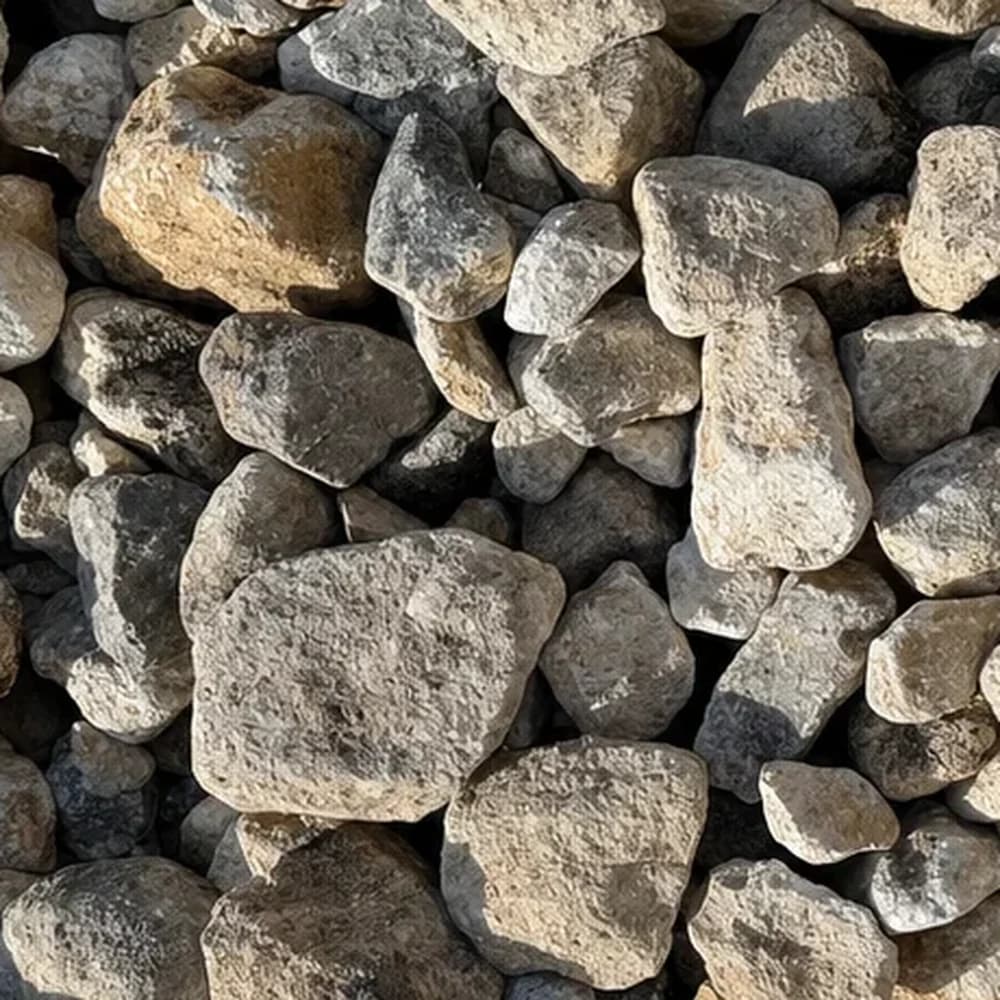
So put non-woven fabric down first and pin it, unless the bed is an active drainage run using drain rock, where the fabric wraps around the stone instead of lying under it. Strip old mulch out rather than laying rock over it. And do not lay rounded stone anywhere ice shove or wave action reaches.
A layer measured off the stone, not off the look you want
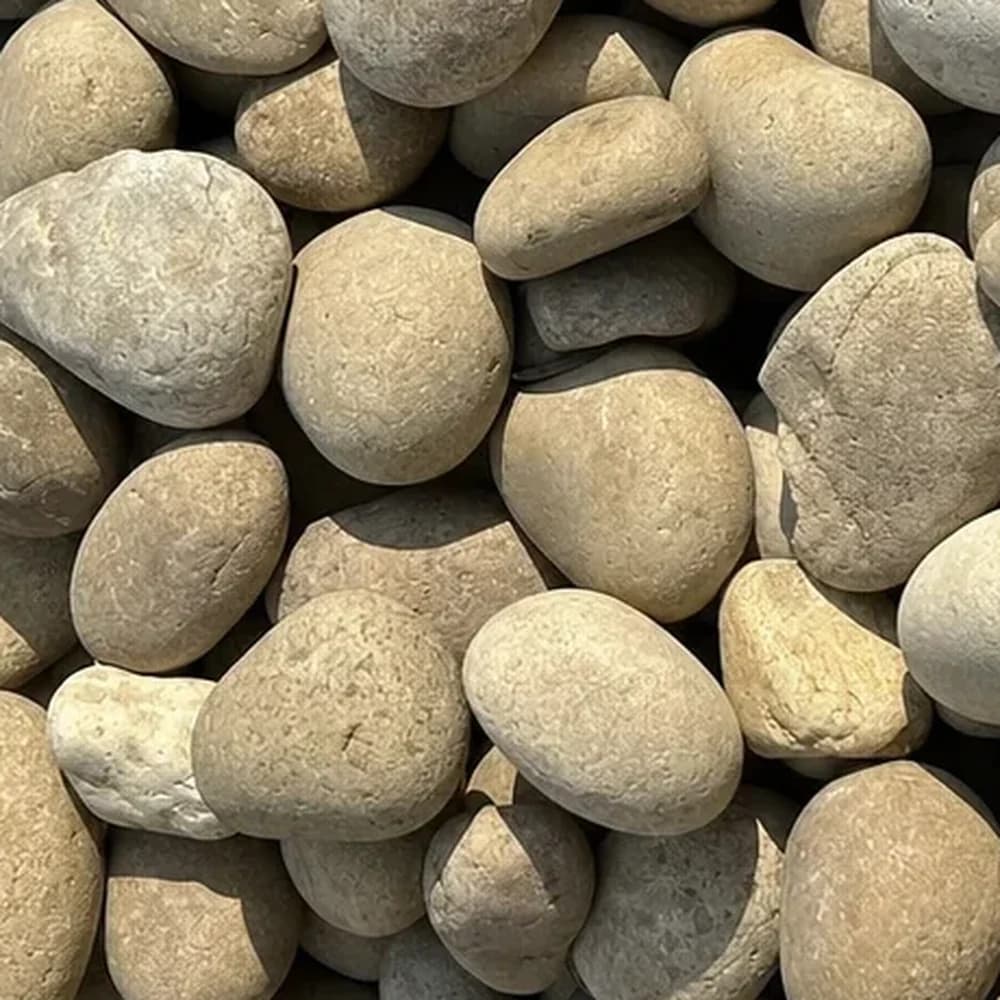
Rounded stone needs a layer roughly twice the diameter of the stone before it reads as cover rather than as scatter.
| Stone | Depth to enter | One ton covers |
|---|---|---|
| 3/4 to 1 inch | 2 in | about 120 sq ft |
| 1 to 3 inch | 3 in | about 80 sq ft |
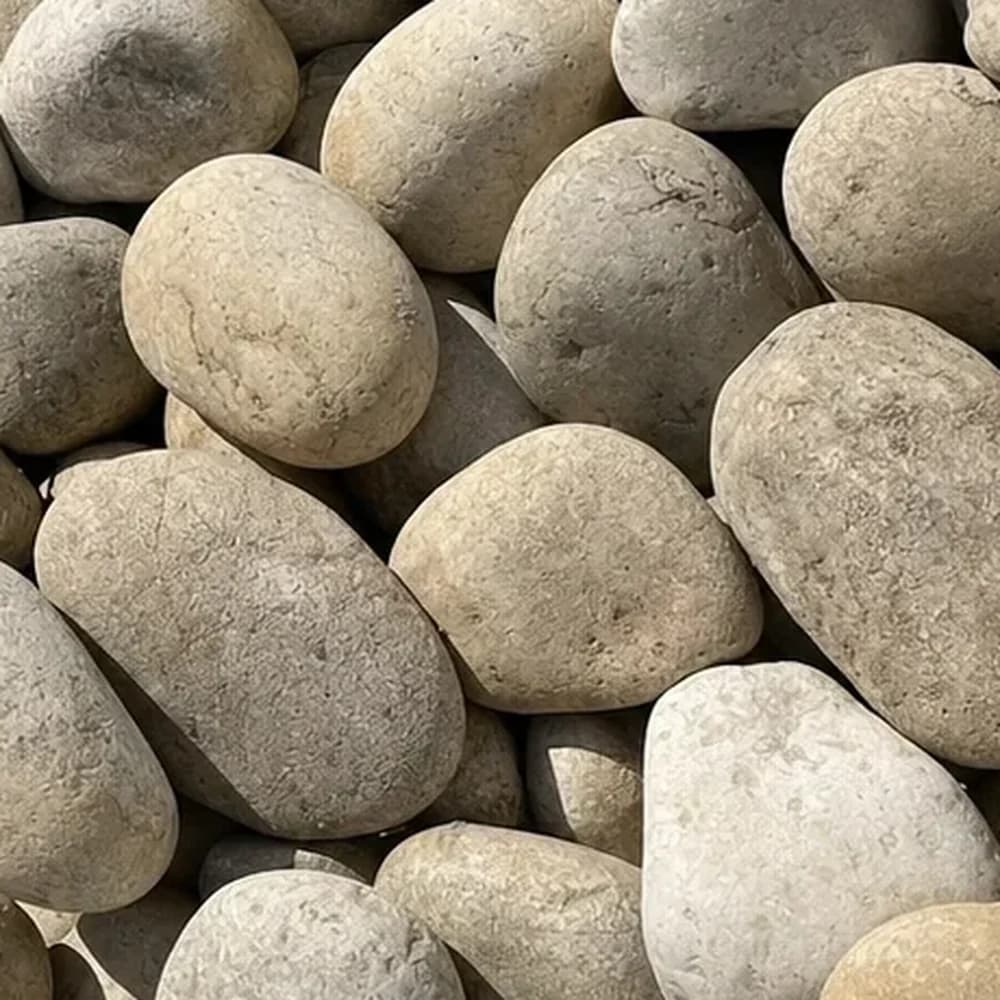
| Large river rock, 2 to 4 inch | 4 to 5 in | about 53 sq ft |
| Oversize accent pieces | single layer | 35 to 50 sq ft |
That table is the whole reason two beds of identical size can be a ton apart. Fabric showing after the rock is spread is a depth problem, not a short delivery.
Weight per yard is the one figure measuring better will not change
A cubic yard of river rock weighs about 2,700 pounds, which is 1.35 tons. Turn that around and a ton occupies only about three quarters of a cubic yard, which is why a two-ton drop looks modest sitting on the drive. Crushed grades at roughly 2,800 pounds and base material at about 3,000 are heavier again for the same space, so the material you select changes the tonnage while the cubic yards stay exactly where they were.
The panel gives you both plus cubic feet. Order on the tons, plan the wheelbarrow runs on the yards.
Checking it on paper: square footage, times the depth in inches divided by twelve, divided by twenty-seven for yards, times 1.35 for tons.
Five beds, a ring and a creek line in one river rock calculator entry
- Shape. Rectangle, circle, or multiple areas, up to five totaled in one result.
- Size. Length and width in feet, or the diameter of a ring bed in feet.
- Depth. Inches, 0.25 to 24. Take the figure from the stone size, not from the budget.
- Material. The select list, which sets the weight used for the tonnage.
- Extra. An optional tick box adding five percent for compaction and spillage, on unless you untick it.
- Result. Cubic yards, tons and cubic feet, with the quote emailable to you.
Fifty-two feet of drip border, and a run below a culvert
Hypothetical jobs, with the arithmetic shown.
The drip border runs 52 feet along the cabin wall at 3 feet wide, taking 3 inches of 1 to 3 inch stone. That is 156 square feet. Three inches is a quarter of a foot, so the bed holds 39 cubic feet, which is 1.44 cubic yards. At 1.35 tons to the yard that is 1.95 tons, so order two and pitch the surplus slightly away from the wall where it carries roof water off.
The culvert run is 34 feet long and 5 feet wide and takes large river rock at 4 inches. That is 170 square feet at a third of a foot, giving 56.7 cubic feet, or 2.10 cubic yards and 2.83 tons. Set the biggest pieces a third of their height below grade so they sit like stone the water put there rather than stone somebody tipped.
Entered together the two jobs come to 3.54 cubic yards and 4.8 tons, one delivery instead of two. Hose the load down once it is spread; delivered rock carries dust that hides the color until the first rinse.
Where ice and spring runoff get at it, the order is rip rap
Rounded stone stays put in a bed and moves in a channel. Once water runs with force, or ice pushes at a bank in March, the material is angular rip rap sized on the rip rap calculator, which works off a slope face and a layer thickness rather than a landscape depth. A dry creek bed that only carries snowmelt is decorative work and belongs here. A shoreline, a stream bank or a scoured culvert outfall is not.
The last quarter ton goes along the road-facing edge
- Tick the five percent for spillage; rounded stone is not compacted, so that is all it is covering.
- Round up to the next quarter ton. A bed short at one end is visible from the road for years.
- Put the surplus at the front edge in a double layer, where cover matters most and thins first.
- Clear leaves with a blower on a low setting rather than a rake, which flicks stone into the grass and then into the mower.
When the tonnage is settled, open the product, set the quantity and a delivery date, and check out. Delivery is arranged at checkout by ZIP code, and the truck needs firm ground to tip on, ideally within wheelbarrow distance of the bed. Shapes you would rather have a second look at can go through the contact page with your figures.
Common questions
Does the material I pick change the yardage, or only the tons?
Only the tons. Volume is set by your length, width and depth and nothing else touches it. The select list applies a weight to that volume, so a bed that reads 1.44 cubic yards stays 1.44 cubic yards whether you choose rounded stone at 2,700 pounds a yard or a crushed grade at 2,800. Order on the tonnage for the material you are actually buying.
Nothing here gets compacted. Does the five percent box do anything for me?
It covers spillage, which on a rock bed means what goes into the lawn off the wheelbarrow and what disappears into the ground at the edges. It is not a settlement allowance, because loose stone does not settle the way base does. On a small bed the more useful habit is rounding the tonnage up to the next quarter ton.
Does a bed on a grade take more rock than the same bed on the flat?
Yes, and the difference is real on a steep run. Measure the length along the ground with the tape laid on the slope rather than reading a flat distance, because that sloping face is the surface you are covering. Depth is measured square to the bed, not vertically. On anything steeper than a gentle fall, expect the stone to creep downhill and edge the bottom.
The bed wraps two sides of the boathouse. Where do I cut it in half?
At the inside corner. Run one rectangle the full length of the first wall, then start the second at the corner so the corner square is counted once rather than twice. Enter both under multiple areas and the tool gives one combined tonnage, which is also the quickest way to see whether the whole job justifies a bulk load.
A row of fieldstone rings the bed. Does that band count as bed?
No. Measure to the inside face of the fieldstone, because that is where the rounded stone stops. Counting an edging band into the area quietly adds a strip the width of the border all the way round, and on a long narrow bed that can be a fifth of the order.
Related calculators
Rock beds are a one-time buy.
River rock, large river rock and drain rock by the ton, free delivery included.