Mulch Calculator for Beds That Come Out of Winter Late
Enter your project dimensions
Snow comes off a foundation bed weeks before the soil under it is ready for anything. Put bark down over cold, wet ground and the bed stays cold and wet, because that is what mulch is for: it holds whatever conditions it finds. Wait until you can push a finger into the soil without it slicking on your skin, then measure. The mulch calculator here adds every bed and tree ring on the property into one cubic yard figure, and shows the bag count alongside it so a bulk load and a car full of sacks can be compared honestly.
Waiting for the beds to drain before the first wheelbarrow
Beds on the tight clay near Green Bay, the Fox Valley and Lake Winnebago hold water long after the lawn has firmed up. Sandy ground in the Central Sands is ready far sooner. Neither is a reason to change the depth you enter, but both change the week you enter it, and mulch spread over saturated clay is the reason so many beds smell sour by June.
Checklist for the walk round:
- Pace each bed and write length and width down as you go.
- Note which beds still hold a usable layer from last year and which are bare.
- Measure tree rings as circles, by their diameter.
- Group the beds by the depth they need, since one run takes one depth.
- Rake the crust off an old layer before you judge its depth.
Depth is a plant decision: bare clay, an old layer, and the trunk
Depth is a plant-health decision more than an arithmetic one.
- Bare or newly planted soil: three inches.
- Over last year's layer, once loosened: two inches on top.
- Past four inches: roots start losing air, and a layer that stays wet at that depth does more harm than the weeds it was meant to stop.
- Playground surfacing: six inches minimum, and certified play chip rather than landscape shred.
- Against a trunk: nothing. Keep bark three to six inches clear and shape the ring flat, not conical, or you invite rot and voles that have all winter to work under the snow.
Adding a foundation border and five tree rings at one depth
- Shape. Rectangle, circle, or multiple areas, up to five at once.
- Size. Length and width in feet for a bed, diameter in feet for a ring.
- Depth. Inches, anywhere from 0.25 to 24, and one figure for every area in the run.
- Material. The select list, which sets the weight the tonnage is built from.
- Extra. A five percent tick for compaction and spillage, which earns its keep more on stone than on bark.
- Result. Cubic yards, tons and cubic feet, with the option to have the quote emailed.
A bed that curves around the corner of the house is two rectangles, taken at its average width. Nobody has ever measured a curved border exactly, and with this material nobody needs to.
Mulch is bought by volume because a yard of it weighs almost nothing
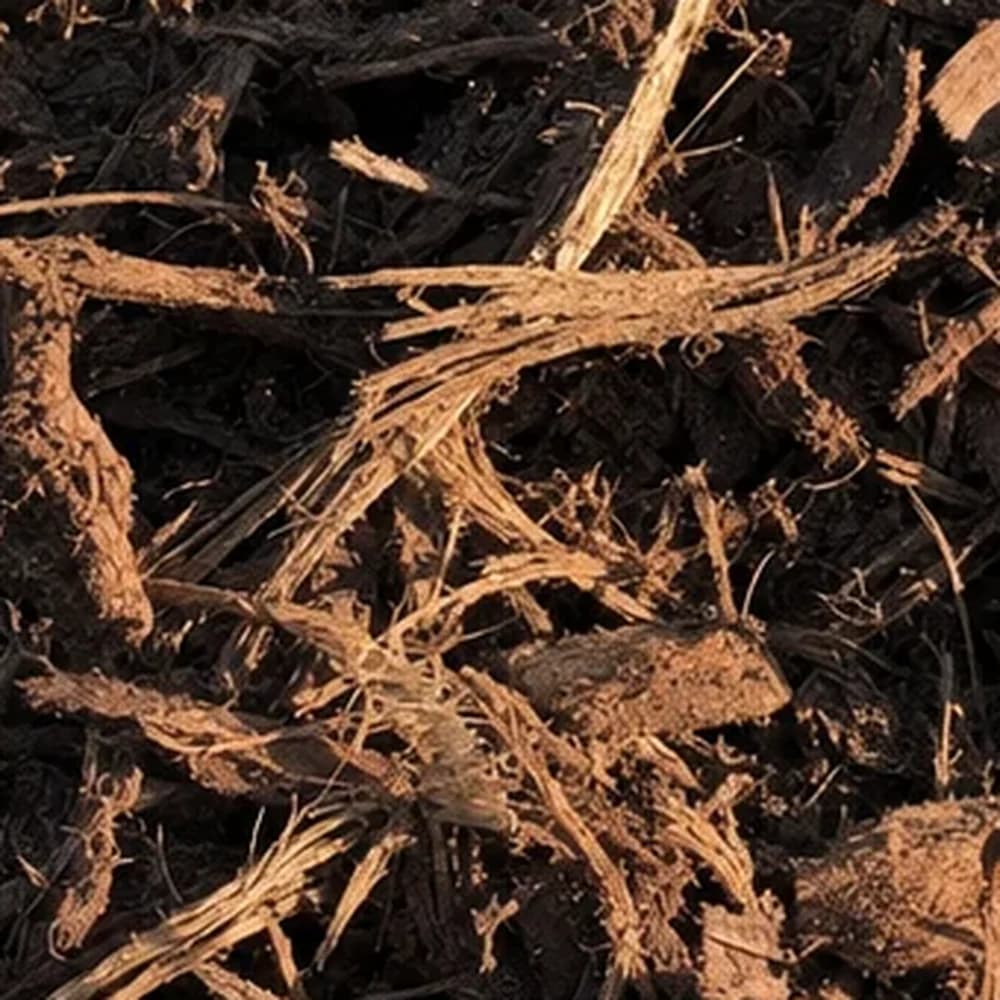
A cubic yard of shredded hardwood runs about 600 lb on this site's own figures, which is 0.30 tons. That is a fifth of what a yard of base stone weighs and a third of what a yard of garden mix weighs, which is why the tons readout on the results panel is the one line you can ignore here. Order on the cubic yards.
The bag comparison is fixed arithmetic. Twenty-seven cubic feet make a cubic yard, so a yard is thirteen and a half sacks at two cubic feet each, or nine at three cubic feet. To check the yardage by hand, multiply the bed area by the depth in inches, divide by twelve, then divide by twenty-seven.
A 46-foot border and five maple rings, worked out
Made-up beds on a made-up lot. Your pacing decides the real ones.
The foundation border down the sunny side
Forty-six feet long, four feet deep, bare after last year's layer broke down. Three inches.
- 46 x 4 = 184 square feet
- 184 x 3, divided by 12 = 46 cubic feet
- 46 divided by 27 = 1.70 cubic yards
- 1.70 x 13.5 = about 23 bags
Five rings under the maples
Five and a half feet across each, three inches, entered as five circles at the same depth as the border.
- One ring: 5.5 feet across gives about 23.8 square feet
- Five of them: 118.8 square feet
- 118.8 x 3, divided by 12 = 29.7 cubic feet
- 29.7 divided by 27 = 1.10 cubic yards, about 15 bags
Together that is 2.80 cubic yards, or roughly 38 bags. Order three yards. The weight of all of it, for curiosity only, is under nine tenths of a ton.
A refresh of the same beds the following spring, at an inch and a half over a loosened layer, comes to about 1.40 cubic yards.
Where a three-yard pile can sit, and how long it keeps
Three yards is a heap the size of a parking space. Put a tarp under it, keep it off new concrete because shredded bark stains, and spread it inside a week or two. A pile left standing a month heats in the middle and sours, which is a smell you will not want near the back door.
Allow thirty to forty-five minutes of wheelbarrow work per yard and hold the last half yard back for the beds behind the garage that never make it onto the list. Order the shredded mulch itself by setting a quantity and a date at checkout, where delivery is arranged by ZIP code and the delivery page covers what the driver needs at your end. If the beds want feeding as well as covering, that layer is garden mix and gets its own run through the soil calculator before any bark goes down. The rest of the tools are on the calculator hub, and anything you would rather talk through goes to Wisconsin Rock Supply via the contact page.
Common questions
The beds are cut into a bank behind the retaining wall. Does the slope change what I measure?
Measure the sloping face itself rather than the flat footprint it covers, because that face is the surface getting bark. Depth stays the same. On anything steeper than a gentle grade, shredded hardwood is the right pick over chips or nuggets, since shred knits together and heavy rain floats loose pieces downhill.
The border wraps two sides of the house. Do I have to add the pieces up myself?
No. Use multiple areas, enter each leg as its own rectangle, and read one total. Five areas is the limit, so on a big property group the small stuff by depth instead: all the bare beds in one run, all the top-ups in another.
Does the strip of steel edging count as part of the bed?
Measure to the inside face of the edging. The edging itself holds no mulch, and on a long border that strip is worth a bag or two of difference. Where a bed simply runs into lawn with no edge, measure to where you intend to cut the line, not where last year's line has drifted to.
The beds need compost worked in as well as bark on top. Is that one order or two?
Two, and in that order. Compost or garden mix goes in first at its own depth and its own weight, and the bark goes over the top once planting is done. Running both layers as a single entry would use one weight row for two materials and misstate the load.
One island bed is a long oval with a curve at each end. What do I put in?
Take a rectangle through the middle at the average width and let the curved ends balance the corners you have added. For bark that approximation sits well inside the error in your own pacing, and half a yard over always finds a home somewhere on the property.
Related calculators
Skip the 27-bag cart.
Bulk shredded hardwood by the yard, tipped in your driveway, delivery free.