Pea Gravel Calculator: Depth First, Then the Edging That Holds It
Enter your project dimensions
Rounded stone does not lock together, so everything about a pea stone surface here comes down to two decisions the pea gravel calculator cannot make for you: how deep, and what stops it traveling. Frost lifts a flush border out of the ground over a winter, and once the border stands lower than the stone, the stone leaves. Get the edging set while the ground is still workable, then put your measurements into the tool and buy to a depth you have actually chosen.
Loose stone can wait, but the edging cannot
Pea stone is one of the few materials on this site that does not need compacting, which means it can go down late in the season when base and paver work has already stopped. The border is the part with a deadline. Steel, aluminum, timber or paver edging all want driving or pinning into ground that is not frozen, and all of them want setting about an inch above the finished stone height so the surface sits inside a lip rather than level with it.
Checklist for the walk round:
- Set or reset the edging before you measure anything.
- Measure to the inside of that edging, not to the grass.
- Check the fall. Above roughly five percent, rain and footfall will move round stone downhill whatever you do.
- On a slope that steep, use a honeycomb stabilizing grid underneath, or pick an angular stone that interlocks.
Depths that suit bare feet, dog paws and a fall zone
- Seating areas, patios and paths: two to three inches. Under two and the ground shows through; over three and every step sinks like dry beach sand.
- Fire ring aprons: three inches, which drains overnight and does not burn.
- Dog runs: two to three inches. Round stone is kinder on pads and rinses clean.
- Playground fall zones: nine to twelve inches, to the equipment maker's instruction, and that is a different order of magnitude from everything above it. What the tonnage buys is landscape pea stone, not certified playground surfacing, and the required depth, the fall-zone footprint and the maintained depth all come from the equipment manufacturer's instructions rather than from us.
Under a patio or seating area, put two compacted inches of Screenings down first so chair legs have something to stand on. That is a second calculation at its own depth and its own weight.
Putting a fire ring apron and a dog run through the tool
- Shape. Rectangle, circle, or multiple areas, up to five totaled at once.
- Size. Length and width in feet, or the diameter for anything round.
- Depth. Inches, from 0.25 to 24, which comfortably covers a twelve-inch fall zone.
- Material. The select list, which is what sets the weight.
- Extra. A five percent tick for compaction and spillage.
- Result. Cubic yards, tons and cubic feet, with the emailed quote.
A path that winds through a garden goes in as three or four straight rectangles taken down its center line. The curves cancel out, and a quarter ton over on loose stone is never wasted.
Pea stone feels light and is not: 2,800 pounds a cubic yard
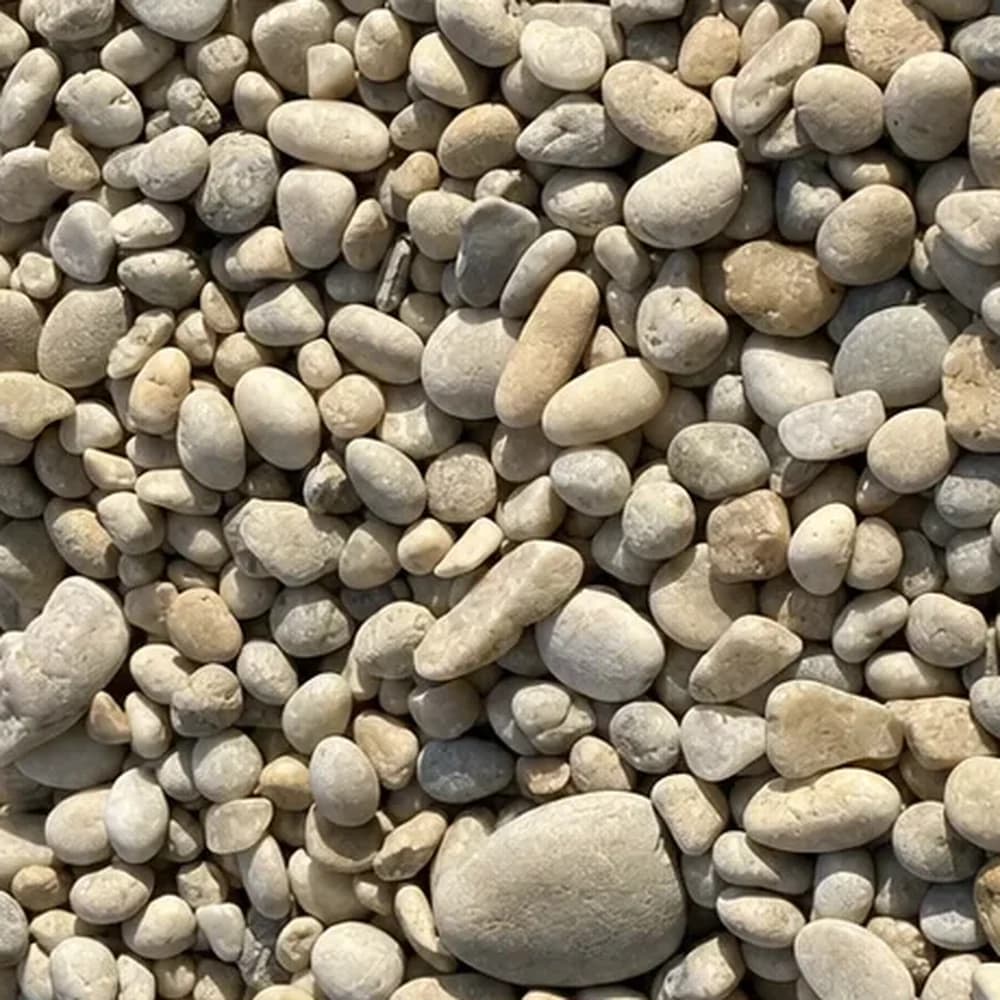
Pea gravel is graded to about three eighths of an inch and publishes here at roughly 2,800 lb per cubic yard, 1.40 tons, which is the same row as crushed gravel and driveway gravel. It feels lighter underfoot because the pieces are smooth, not because there is less stone in a yard; rounded pieces nest with less air between them than people expect. River rock, at about 2,700 lb or 1.35 tons, is the lighter one.
To check the tool by hand, divide the depth in inches by twelve, multiply that by your square footage for cubic feet, divide by twenty-seven, then put 1.4 tons on each yard.
A 13-foot fire ring apron and a 14 by 10 dog run
Made-up jobs on a made-up lot.
The apron round a fire ring
Thirteen feet across, three inches deep, entered as a circle.
- A 13-foot circle is about 133 square feet
- 133 x 3, divided by 12 = 33.3 cubic feet
- 33.3 divided by 27 = 1.23 cubic yards
- 1.23 x 1.40 = 1.7 tons
The dog run behind the garage
Fourteen by ten feet, three inches.
- 14 x 10 = 140 square feet
- 140 x 3, divided by 12 = 35 cubic feet
- 35 divided by 27 = 1.30 cubic yards
- 1.30 x 1.40 = 1.8 tons
Both together is three and a half tons. Now the same tool on a fall zone under a swing frame, twenty by seventeen feet at twelve inches: 340 square feet, 340 cubic feet, 12.6 cubic yards, 17.6 tons. Well over twice the area of that dog run, and nearly ten times the stone, which is why a play surface is worth calculating rather than guessing.
A quarter ton held back for the line that wears first
Every pea stone surface develops a traffic line: to the gate, to the fire ring, to the shed door. Keep a couple of buckets aside when the load arrives and top that line the following spring, and rake the whole surface level twice a year while you are at it.
Tick the five percent on anything you will be shoveling off a pile, and round up. Loose stone in a bordered bed needs no more than that. When the tonnage looks right, open pea gravel, set the tons and a date and check out; delivery is arranged at checkout by ZIP code and the delivery page covers what the truck needs. If the ground falls away and you would rather have something that interlocks, walkway gravel is sized on the gravel calculator, and decorative beds belong on the river rock tool.
Common questions
The garden path falls away toward the creek. Does the grade change what I should order?
It changes both the measurement and possibly the material. Run the tape along the sloping surface rather than the flat distance beneath it, since that is the area getting covered. Then judge the fall: past about five percent, rounded stone creeps downhill season after season, and either a stabilizing grid underneath or an angular stone that interlocks will save you re-raking it every spring.
The dog run wraps around the back of the garage in an L. Two calculations?
One, using multiple areas. Enter the two legs as separate rectangles and take care not to count the corner square twice. The tool adds up to five areas and gives you a single tonnage, which is all you need for one delivery.
The timber border stands an inch proud of the stone. Where does my measurement stop?
At the inside face of the timber. That lip is the whole point of setting the edging high, and measuring to the outside of it adds stone you have nowhere to put. On a narrow path the difference between the two is a surprising fraction of a small order.
The seating area wants a firm layer under the stone. Is that one order or two?
Two. Two compacted inches of Screenings go down first, sized on their own run through the stone tool at about 2,900 lb a yard, then the pea stone goes over at two to three inches at 2,800 lb. Different depths and different weights, so they never share an entry.
The fire ring apron is a circle with the pit in the middle getting nothing. What do I enter?
Enter the full outer diameter and accept the small overage. Subtracting the pit means a second calculation to take away a few square feet, and on a job this size the leftover stone is worth more in the wheelbarrow than the arithmetic is worth on paper.
Related calculators
Under two tons covers most patios.
3/8 inch natural pea gravel, priced by the ton, delivered free.