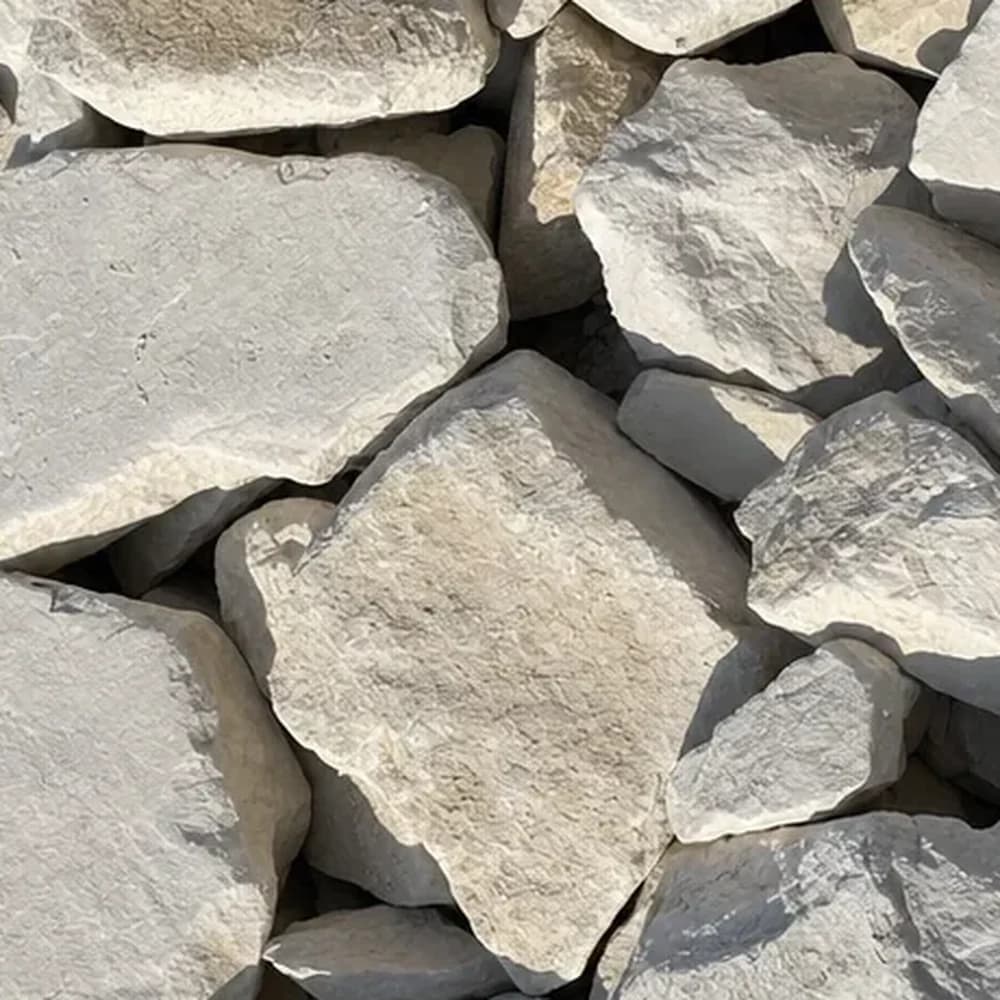
Rip Rap Calculator: Fifty-Five Feet of Coulee Stream Bank, in Tons
Enter your project dimensions
Most people arrive at a rip rap calculator with the same job in front of them: a bank that lost ground in one storm. In the Driftless coulees that is runoff off a ridge-top field cutting into a stream bank overnight. Along the Lake Superior shore it is red clay slumping where groundwater and freeze-thaw have been working at it all winter. Either way the fix is a layer of armor stone, and the fastest way to understand what that costs in tonnage is to follow one bank all the way through.
Fifty-five feet of coulee bank, measured and ordered
Say the cut runs fifty-five feet along the stream, and the exposed face measures four and a half feet from the toe up to where the grass starts. The stone is four to twelve inch, so the layer goes in at eighteen inches.
- Face area: 55 x 4.5 = 247.5 square feet
- 18 inches is 1.5 feet, so 247.5 x 1.5 = 371.25 cubic feet
- 371.25 divided by 27 = 13.75 cubic yards
- 13.75 x 1.55 = 21.3 tons
Order twenty-two. Then the layer underneath: either non-woven geotextile, which comes from a landscape supplier rather than this catalogue, or three to four inches of #4 crushed stone as bedding. At four inches over the same face, that is 247.5 x 0.333 = 82.5 cubic feet, 3.06 cubic yards, and at about 1.45 tons a yard, roughly 4.4 tons. Stone laid straight onto bare clay settles as soon as water pulls the soil out from under it.
Run the tape from the toe up the slope face
The measurement that decides everything here is the one people get wrong. Do not measure across the ground from the top of the bank out to the water. Measure up the face itself, the way a rope would lie on it, and multiply that by the length of the bank or channel.
Checklist before the arithmetic:
- Take the face height in three places. Banks are rarely one height for fifty feet.
- Shape the slope to 2:1 or flatter first. Anything steeper is an engineering job, not a stone job.
- Set the toe below the waterline or below where scour reaches, because undermining starts at the bottom.
- On a culvert, the apron runs four to six pipe diameters past the outlet.
Before any stone goes below the ordinary high water mark of a lake, stream, pond or flowage, find out what approval your state and local authorities require. Placing rock in and along water is commonly permitted work, and what is asked for depends on the waterbody.
Layer thickness comes off the biggest stone, not off the look of the bank
Set the layer at one and a half to two times the largest stone dimension, and never under twelve inches. Four to eight inch stone on a quiet pond bank or a downspout outfall usually lands at twelve to eighteen. Faster water and bigger stone push it toward twenty-four. Highway and spillway work carries its own engineered classes and depths, and those come off the drawing rather than off this page.
When the choice is close, take the larger stone and deepen the layer. Weight is the only thing holding it in place.
- Shape. Rectangle, circle, or multiple areas up to five, which handles a bank that turns a corner at an outfall.
- Size. Length of bank and height of face, both in feet.
- Depth. Inches, up to 24, so a two-foot layer fits.
- Material. The select list, which sets the weight.
- Extra. The five percent tick for compaction and spillage.
- Result. Cubic yards, tons and cubic feet, with the emailed quote.
The heaviest material in the catalogue, and the one that covers least
Armor stone publishes here at about 3,100 lb per cubic yard, 1.55 tons, which is more per yard than anything else sold on this site. At a twelve-inch layer a ton covers roughly seventeen square feet. At eighteen inches it covers about twelve. The same ton of landscape rock spread two inches deep covers well over a hundred square feet, and about eighty at three inches, which is why a rip rap order looks so large next to every other order on the property and why the pile that arrives looks so small for the tonnage on the ticket.
Checking by hand: face area times layer thickness in feet gives cubic feet, divide by twenty-seven for yards, then 1.55 tons on each yard.
Rip rap, #4 bedding stone and river rock are three separate orders
- RipRap is the armor layer, sized by water force and set with the pieces nesting into each other rather than lying where they were tipped.
- #4 stone or ballast is the bedding course under it, at about 2,900 lb a yard.
- River rock is decorative. It belongs in a dry creek bed or a border, not on a bank that takes moving water, and sizing it on the river rock calculator will tell you so with a much smaller number.
Place the toe row first, work up, and hand-set the top course so the faces key together. Stone up to about six or eight inches can go by hand. Beyond that it wants a machine.
Ice shove in March, and the reserve pile it earns
On an inland lake, a spring ice sheet driven by wind will push stone up a bank and leave a gap behind it. On a coulee stream it is the first heavy summer storm that moves things. Either way, walk the bank once the water drops and look for three things: stone shifted off the toe, bare soil showing between pieces, and fabric exposed to daylight. Ten minutes twice a year is the whole maintenance job.
Keep a few tons back for that walk rather than ordering exactly to the calculation. Check the access route before you commit, too: a loaded truck can bog in the last twenty feet of a wet approach, and stone dropped in the wrong place gets paid for twice in handling. The delivery page covers what the driver needs. When the tonnage is settled, set your quantity and a date at checkout, where delivery is arranged by ZIP code, and send anything the tool will not divide to the contact page with the bank measurements written down.
Common questions
I have my tonnage. Which product page do I actually order it on?
The RipRap page, by the ton, with the size range chosen for the water rather than for the look. Order the bedding at the same time on the #4 stone page so both arrive together, because the armor layer cannot go down until the course beneath it is spread.
Where can twenty-two tons realistically be dropped on a bank job?
On firm level ground as close to the toe as a loaded truck can reach without leaving the track, and upstream of the work rather than below it. Walk the route first in the conditions you expect on the day. Moving armor stone a second time by machine costs more than the whole bedding course did.
Why does the panel show cubic yards when armor stone is bought by the ton?
The cubic yards are the volume of the layer, and the tons are that volume multiplied by the weight of the material selected. You order in tons, but the yards figure is the one to sanity-check against your face area and thickness, because an error in the measurements shows up there first.
Is the layer thickness I type the loose depth or the settled one?
The finished thickness of the placed layer, set at one and a half to two times the largest stone. Armor stone is not compacted the way a base is; it is keyed together by hand or bucket, so what you place is roughly what you keep, minus whatever works down into the bedding in the first season.
A culvert has scoured a round hollow below the pipe. Which shape mode handles that?
Circle mode. Extend the armored area four to six pipe diameters downstream of the outlet first, then measure across it and enter that as the diameter. An eight-foot circle at a twelve-inch layer works out at about 50 square feet, 1.9 cubic yards and roughly 2.9 tons, with bedding underneath on top of that.
Related calculators
Banks don't armor themselves.
RipRap by the ton with free delivery, plus the #4 bedding stone to go under it.