Bulk Landscape Materials Sorted by the Layer They Belong In

River Rock
The smooth feel of River Rock suits Wisconsin planted edges and water features needing a rounded stone finish that drains. Size: 1 inch to 3 inches. Type: Smooth, naturally rounded stones. Color: Tans, grays, browns and occasional reds.
Free Delivery

Large River Rock
Use Large River Rock in Wisconsin where an exposed dry channel or water feature border needs visual weight instead of a light accent finish. Size: 2 inches to 4 inches. Type: Smooth, naturally rounded stones. Color: Tans, grays and browns.
Free Delivery
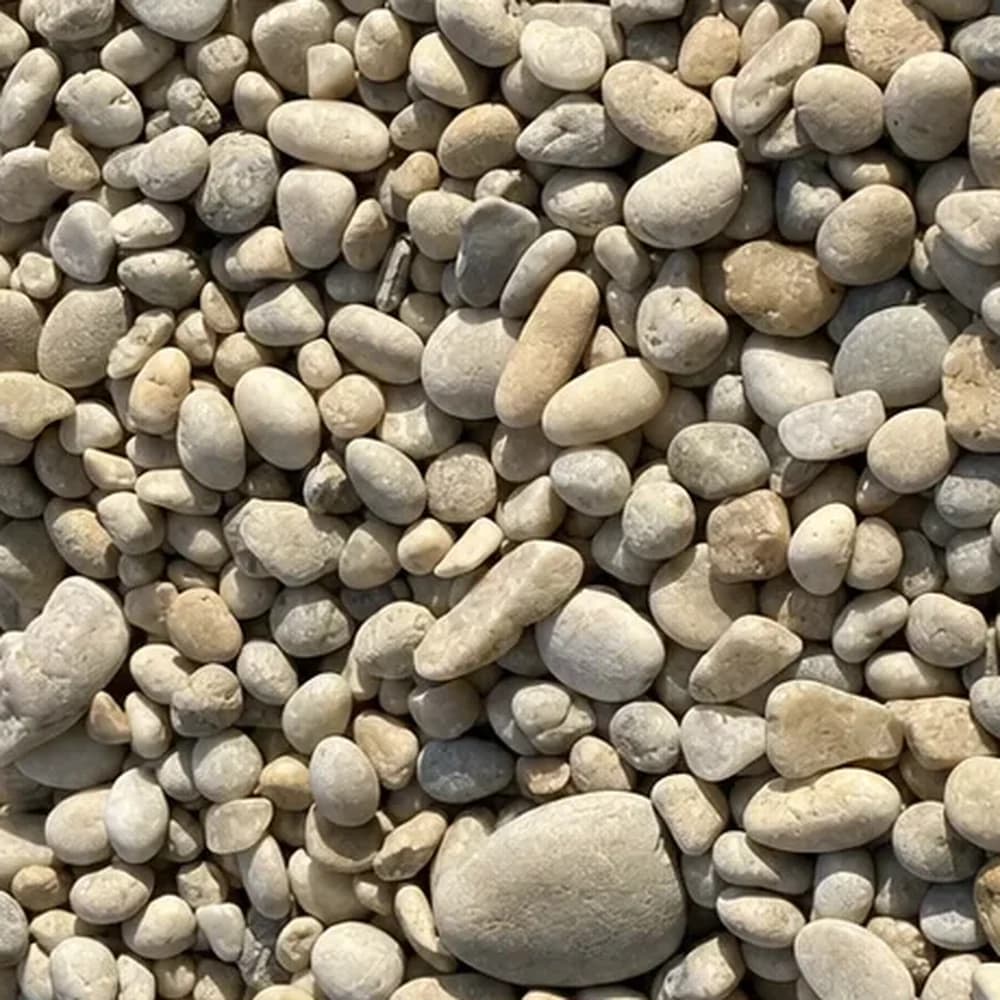
Pea Gravel
A common Wisconsin mistake is treating Pea Gravel as a fix for water problems below the surface. It suits smooth walking areas and drainage finishes. Size: Approximately 3/8 inch. Type: Small, smooth, naturally rounded stones. Color: Tans, creams, grays, browns and occasional reds.
Free Delivery
Three jobs account for most of the orders that start on this page: a lane that ruts once the frost comes out, a low corner that holds meltwater every April, and a bank that lost ground over the winter. The catalogue below is arranged around those, because an alphabetical list of bulk landscape materials tells you nothing about which one goes under which.
Red clay, outwash sand and Driftless silt want different things
- Lake clays around Green Bay, the Fox Valley and the Lake Michigan shore, and the red clay plain on the Lake Superior side, drain slowly and stay wet well past the thaw. Build deeper, and get the water off with a crown and a ditch.
- Central Sands outwash drains fast once the frost leaves. The base is there to carry the load rather than to fix drainage.
- Northern till and stony sandy loam vary within one lot, with peat and muck in the low ground. Dig a test hole before settling a depth.
- Driftless silt loam over sandstone and dolomite is thin on the ridges and soft in the coulees, and hillside seeps undercut anything laid without drainage.
- Frost reaches at least 48 inches under a footing in the state dwelling code, and 48 to 72 inches under a road by late winter, so no aggregate layer is going below it. Depth and drainage are what a base has to offer instead.
Under the wheels: sub-base and base
- Breaker Run is stone taken through a primary crusher to 6 inches or less. It is the heavy sub-base for soft or wet ground and for a construction entrance, and it normally gets capped rather than driven on.
- 3/4" Traffic Bond is the dense graded base Wisconsin yards sell under that name, a 1 inch minus blend of crushed stone, gravel and binding fines. It packs hard and holds a crown. Both names are how a contractor writes this material on an estimate here, not a certification attached to the load.
- Railroad Ballast and #4 Crushed Stone are the coarse open stone for equipment standing, track beds and trench bottoms where water has to run through under load.
Where water has to keep moving
Fines are what make a layer pack, so clean stone is the opposite choice. It never compacts, and that is the point.
- Drain Rock, washed clear of fines, for French drains, foundation drains, downspout runs and backfill behind a wall.
- 3/4" Crushed Stone, the clear stone most often specified around pipe and foundations.
- #57 Stone and #67 Stone for drainage and concrete work, the second a size smaller.
- 3/8" Crushed Stone, #8 Crushed Stone and #89 Crushed Stone for pipe bedding, permeable paver details and tight joints.
Surfaces people walk and drive on
- Driveway Gravel tops a compacted traffic bond base or refreshes a worn lane.
- Walkway Gravel gives a finer, walkable finish on a garden route.
- Screenings is what stone dust is called here, the bedding under pavers and flagstone and a hard-packing dressing on a drive.
- Pea Gravel suits play areas, dog runs and paths, rounded and comfortable underfoot, and it will not pack.
- River Rock and Large River Rock are the decorative and dry creek bed choices, the larger size where a channel needs weight.
Soil, fill and mulch for the growing half of the year
- Fill Dirt raises low ground and backfills before anything finer goes on.
- Top Soil is sold pulverized, the black dirt for a new lawn, grading and bed prep.
- Garden Soil is the topsoil and compost blend for raised beds and planting areas.
- Shredded Mulch holds moisture in the beds through a dry July.
- Mason Sand and Washed Sand cover mortar work, paver joints, play sand, bedding and leveling.
Shore, bank and culvert outlet
RipRap is the heavy armor for lakeshore, stream bank, culvert outlet and slope work, where wave attack, a high lake year, groundwater seepage and freeze-thaw all pull at the same face. It is the heaviest thing in the catalogue at about 3,100 lb per cubic yard by this site's published figure, so lay it in real thickness rather than scattering it, over a filter fabric from a landscape supplier.
Pick the layer, then the material, then a quantity. The material calculators turn measurements into cubic yards and tons, and the delivery page covers what the truck needs at the drop spot.
Common questions
Is this sold by the ton or by the cubic yard?
Stone and gravel go by the ton, and soils and mulch go by the cubic yard. Each product page states which. The calculators return both figures for the material you select, so you measure once and read the number that matches the unit on the page. The two are not interchangeable because weight varies enormously between materials.
What does the truck need to get in?
Roughly 12 feet of clear width the whole way, somewhere to turn or back out, nothing hanging low overhead and firm ground to tip on. Overhead branches on a wooded lake drive and a service wire across a yard stop more deliveries than narrow gates do. Mark the drop spot so the driver is not guessing.
Why does one estimate call for clean stone and another for material with fines?
They do different jobs. Fines fill the gaps between the larger pieces and let a layer tighten under compaction, which is what a driving surface needs, so traffic bond and breaker run both carry them. Clean stone has the fines screened or washed out, so the voids stay open and water keeps moving through, which is what a trench or a wall backfill needs. Using one in the other's place is the most common mistake on this list.
How much deeper should the base be if a loaded truck uses the drive?
Deeper than for a car, and the subgrade decides how much deeper. Sandy outwash spreads a load and drains, so it takes less. Clay that stays wet into May takes more, and under a propane truck or farm equipment it wants breaker run as a sub-base with compacted traffic bond above it, placed in lifts rather than tipped in one go. Quote yourself the compacted depth when you order.